Join the mailing list plus receive your free How to Become a Successful Coach Starter Kit.
Join + get your Starter Kit
Real people. Real stories. Real success. With Rashid Mubashir.
© 2026 How to Become a Successful Coach
Real people. Real stories. Real success. With Rashid Mubashir.
Why we learn to wear masks, and the three questions that uncover what is underneath.
Somewhere early on, most of us worked out that showing up exactly as we are was not entirely safe. So we adjusted. We learned the rules of the family, the school, the workplace, and we became the version of ourselves that fitted them. Andrea Buck calls that the mask, and she has spent years helping people take it off.
In this conversation Andrea and Rashid go into why the mask goes on in the first place, what happens in those first seven years when we are still a sponge, and how the messages we absorb then quietly become the rules we live by decades later. They also sit with a harder question: when you feel something in your body, how do you know it is your own truth speaking and not old fear? Andrea’s answer is that fear and doubt are loud, and your essence is quieter, which is why hearing it takes slowing down and usually another person who can listen without judgment.
Andrea also tells her own story. The analyst programmer job she could not get through the day at, the tightening in her body on the tram every morning, and the question from her sister years later that started everything again: why don’t you do something you love?
She finishes with three things anyone can do this week to start finding their way back.
The mask goes on early. Most of us learned that showing up exactly as we are was not safe, so we adjusted to fit the rules around us.
Fear and doubt are loud. Your essence is quieter. Hearing it takes slowing down, and usually another person who can listen without judgment.
Your body is already giving you the feedback. There is a difference between the challenge of pursuing something that matters, and the drag of a life that is not yours.
A definition of success handed to you by your parents or the culture can be reached in full and still feel empty. The first question is what a good life means to you.
Andrea’s three starting points: ask five people what they think is special about you, notice when you lose track of time, and answer what one thing you would want a younger generation to know.
Prefer to read? Download the transcript, or open it right here.
Welcome to this podcast. Today I'm here with Andrea Buck. Andrea Buck is a genius coach and a lifetime member of the International Coaching Institute. And today, we are here to explore how Andrea works with her clients to help them develop their inner self-esteem and finally learn how to express themselves authentically in a world that can be muddled with chaos and pretentiousness.
When people can wear a mask so they can feel like they belong, Andrea and her work is very unique because she takes people on a deep journey, and we're going to explore how she does that and how someone watching this can do that as well. Andrea, welcome to this conversation.
Thank you, Rashid. Awesome to be here.
Yeah. So welcome. I'm so excited about this. Andrea, you and I were chatting just before starting this, and you shared with me that you help people develop a sense of authenticity in them so that they can express their genius as well as they can and live this life as true to who they feel they are, as they possibly can.
Start with what happens for people to even become someone who is not authentic. Yeah, right. What happens to somebody? We live this life, which is creative in every moment, right? Just being humans, the nature of it and the nature of the world is creative. And so to be creative in that sense. Okay, so the universe is creative.
So everything is being born and developing and growing and dying, and every moment of your life, you are creating who you are, how you show up, what you express, what you make, what you do. Whether it be what dinner you make, the garden that you're growing, how you set up your house, the decisions you make, the business you build, everything that you do is an expression of creativity.
We are born perfect, authentic, curious, courageous, divine. Also, as we grow up, we learn to protect ourselves from potentially not belonging, from not being loved. We build masks. We learn to fit in with our tribe, to fit in with our families, to fit in with the culture around us, to not be too loud, to not be too much, to not cry too much. All of this, these judgments that are coming at us.
Yeah. So what I'm hearing is it's almost like we learn how to be less of ourselves.
Yes. Yes. So the first thing to be authentic is to remember who you were, to come back to yourself. And that requires getting rid of the noise and getting back to who you actually are.
So it's not about building something new. I mean, I call it living your genius. And part of it is you have to find your genius. But really, it's about uncovering your essence. So for me, genius is your essence. It's your pure essence. And we all have a genius. So when I call you, it's beautiful hearing you say the genius coaching.
Okay, well, that is, you could think of it as like, I am a genius coach, but really, it's. I coach the genius in people and how they express and help them live it.
Yeah. So how do you do that? Because people and all of us have had this journey, you know, to give up aspects of ourselves.
Yeah, because of the tribe we grew up in, the family we were, or maybe the environment and circumstances. Yeah. And it may not have been intentional by our caretakers or in some cases, maybe it was, however it was. Yeah. We and I like how you said we are born in our essence and we are born with qualities. And we have all these wonderful aspects of ourselves.
Yeah. And then we step into what we might call authenticity. Yeah. So how do you help someone unlock that?
Okay. Awesome. So Andrea, let's start the conversation with when you're working with someone who is experiencing self-doubt, they are facing challenge in life, maybe even feeling like they're not good enough in some way and they are putting this mask on which all of us have done in our lives. What do you find is the reason why they are doing that? Why do people put on masks?
Yeah. What a great question. So generally people are wearing a mask because they're afraid of just showing up authentically with who they are. So it's the fear of judgment, fear of not fitting in. They have people have been taught that it's not necessarily safe to just say things the way they are and show up who they are. So it's fear of authenticity. And that is where the gold lies. That's where the magic is.
Yeah. That's really interesting because I would imagine that a lot of that perception of we're not safe comes from early childhood experiences or from the tribe or the culture that we're in. Yeah, so we internalize these messages and then we carry them into adulthood. And then these masks become our normal. We don't even realize we're wearing them anymore.
When you're able to shed those masks and be authentically who you are, what does that look like for people? What transformation happens?
So one of the greatest transformations that I see is people stepping into their power and their truth. And they stop asking permission to be themselves. They're no longer playing small. They're actually expressing who they are and what they believe in. And from that place, their lives completely transform. They are more confident, more alive, more joyful. They're expressing themselves. They're making bolder decisions. They're having deeper relationships. They're creating the life that they actually want instead of the life that they think they should be living.
That's beautiful. So it sounds like there's a lot of freedom in that.
Absolutely. Yeah. It's like the greatest freedom you could ever have is to just be yourself.
Yeah. So how do you help someone get there? What does that journey look like?
So the first thing is to recognize that you are wearing a mask. Most people don't realize they're wearing a mask. So I help people get curious about how they show up in the world. What are the places where they feel like they can't be themselves? Where do they feel like they have to perform? Where do they have to hide? And from there we start to peel back the layers. We look at where these masks came from. What were you afraid of? What were you protecting yourself from? And then we start to question whether you need that protection anymore.
Because a lot of times these masks were created to keep you safe as a child but now as an adult they're actually holding you back. So we start to rebuild your relationship with yourself and with others. We start to rebuild your confidence and your self-worth. And we learn how to express yourself in an authentic way that still honors your relationships and the people around you.
What does that look like practically? Like when someone comes to you, what's the process?
Well, so there's different ways that people need to work on this, right? Some people need to understand what authenticity means. Some people need to heal trauma. Some people need to work on their self-esteem and self-worth. So it depends on where they're at. But generally what I do is I create a safe space for people to explore who they are. I help them get curious about their patterns and their behaviors. I help them understand where these came from. And then we work together to create new ways of being.
And we do this through coaching conversations, through reflective practices, through different exercises that help people get in touch with their authentic self. And we also work on practical strategies for how to express themselves in their day-to-day life in authentic ways.
So it's a combination of inner work and outer work. Yeah, that's right. You're helping them understand themselves more deeply and then you're giving them tools for how to actually be different in the world.
Yeah. And it's so important because a lot of people know intellectually that they should be authentic but they don't know how to actually do it. So the coaching piece is really important.
So one of the things I'm really curious about is when you say safe space, what does that mean? Because I think a lot of people hear safe space and they think, oh, that's just a place where nobody's going to judge me. But I think there's a lot more to it than that.
Yeah, absolutely. So a safe space for me is a place where you can be completely honest about how you feel, what you think, what you believe, without any fear of judgment or rejection or abandonment. It's a place where you are met with compassion and acceptance exactly as you are. It's a place where your feelings are validated. Your experiences are honored. And you're allowed to be messy and imperfect and human.
And it's also a place where you can be challenged. Right? Because sometimes people need to hear things that are hard to hear. But in a safe space, that challenge comes from a place of love and from someone who genuinely cares about your wellbeing and your growth. So a safe space is really about being held by another human being with compassion and acceptance and genuine care.
That's really powerful. So it's not just about the absence of judgment, it's about the presence of something. It's about the presence of being truly seen and heard and valued.
Yes. Absolutely. That's exactly it. And I think that's one of the things that's missing in our world today. We don't have a lot of places where we can be truly seen and heard. We're all so busy. We're all so caught up in our own stuff. And we don't take time to really listen to each other with our full presence and our full heart.
And what I find is that when people experience that kind of presence, that kind of deep listening, that kind of acceptance, it's transformative. It allows them to relax. It allows them to access parts of themselves that have been shut down. It allows them to remember who they are.
So when you're helping people access their authentic self, are there things that they need to do internally? Like are there practices or things that help?
Yeah, absolutely. So there's journaling, meditating, quieting down, generally spending time in nature. And these are things that people know about. And most people are doing. Yeah. And also and really powerfully, something really powerful is having a safe space where you can be seen and be heard and hear yourself with no judgment, and validation and being with another human being.
Absolutely. And, you know, you could get this anywhere, but not everybody has access to that. And not everybody has people around them who've even got the time and who have no vested interests in the outcome of this conversation where you feel safe. Or have the skills. Absolutely. It's like, I don't think many of us were told yeah, how to actually be there for someone.
How do you know they would need someone fully in their heart, in their pain and the sorrow in their grieving and challenge, in their sadness and their joy in their comfort and their adventure? How do you not tear someone down? Yeah. Without realizing. Yeah, yeah, yeah. To minimize someone without realizing. Yeah. And the other, the other really big thing that I didn't know until I started coaching was that I always knew that children cannot self-regulate.
You need a parent to help you to basically teach your nervous system how to regulate. Why you realize that adults need co-regulation as well. So what have you in relationship with somebody who doesn't hold the capacity to learn the skills? They haven't learned the skills, so maybe they suck at their own damage in childhood going on.
So to be with somebody who is mature and understands and has the capacity to co-regulate just that, like even if it's not a conversation, it is the energetic that is happening between you and your trusted coach. That's amazing.
Yeah. Good. I love this. So are what is that safety do? So that we were talking about needing to quieten down and listen.
Yeah. So when you're activated you can't listen. When you're activated your nervous system is activated. You're going into fear, fight, flight. Your creative and your cognitive capacity is diminished because all of your energy is going into your survival. Yeah. So when you regulate it you can slow down quieting down. Then you hear the truth of the messages coming for you, not the fear responses.
And that also explains the conversation we were having earlier about how do you separate the voices inside from fear? Yeah. And from trauma, the past and the now, which is that a lot of people probably don't really get to experience with that, truly within themselves, because unless you are able to create that safe space within yourself, or you have someone that can do that with you in regulation, we are probably being driven for most part of our lives by that dysregulation.
Well, and in that space, we can't access the essence. That's exactly right. And we know it's ramping up and the world's getting faster and faster. And we live in such a dopamine driven world now that is, you know, scrolling and that and that's and I find that nervous system activating. And that's exactly the opposite of where we need to be.
We talk about co-regulating with our clients. It is also creating communities. Most coaches I know, certainly I have strong creative communities where people can show up, where they can be vulnerable, where they can talk about the actual challenges they're having of judgment free. And so it's it's not a it's on a personal, deep emotional level feeling seen and heard.
But then also within that being given practical strategies and connections and you know, the how you can do life in a practical way. So you're getting both levels of the internal world and the external world shared within a community of like-minded people who have the same journey.
Yeah, yeah, I love that you're doing amazing work, Andrea. Thank you.
I would say we could probably keep chatting for another couple of hours, I think, which is awesome. But before we finish, I'll share with us maybe three simple ways how someone can start today to learn about themselves, who they really are in their essence so that they can be more authentically self-expressed.
I think one lovely way and we talking about going internal right? And to find your internal place, why don't you go external? Because actually sometimes we don't see what we are amazing at and we are afraid of bragging a little bit, even to ourselves. So find five people in your life and ask them what they think is amazing about you and special about you, and listen to what they say. Have like a mirror. Yeah. That's awesome. Great.
So that's one. Yes. Give me another one.
Yeah okay. And then another one is to notice on your day to day life when you feel in flow like what I mean by that is when you just time passes, you just love what you're doing. It might be as simple as when I'm in conversation with somebody. It might be looking to a friend? Yeah. Which is an immediate indicator that yes, there's more meaning and joy and danger in that.
Yeah. Yes. One more. If you had only one thing that you could impart to the world about what your life has meant to you. What is one thing? So if you and the third one is what message you have. Like, what is your life meant to? What is the meaning? So to find your way to that, if this was your last day on Earth and you had a message to your younger self or to a younger generation, like, what is one thing that matters most? So what is that one thing?
Yeah, I love it. That's a really good exercise. I'm actually going to do all three of them. I'm going to reflect after this. But the first one I really dig as well, which is the five people. Yeah. And ask them. I've never done that. Haven't you done that. I'd love to do that. Yeah. Please do that. Totally. Oh, I'd love it if you came back and shared with me what you found.
I'd love that. Yeah. Okay. Thanks so much.
Thank you. Thank you, Rashid. And I'm looking forward to many more.
Thank you for joining us. Thank you so much.
So thank you so much, Andrea, for joining us today. It's been an absolute pleasure. And I've really enjoyed going in all these different directions to explore how people hold themselves back and can express themselves in many different ways and what it means to them. And I'm just looking forward to the impact you continue to make in the world.
Thank you. Thank you, Rashid. What a pleasure talking to you. Totally. I'd love to give you a big hug. Oh, awesome. Thank you very much. She is so lovely. Thank you, Andrea. Well, thank you.
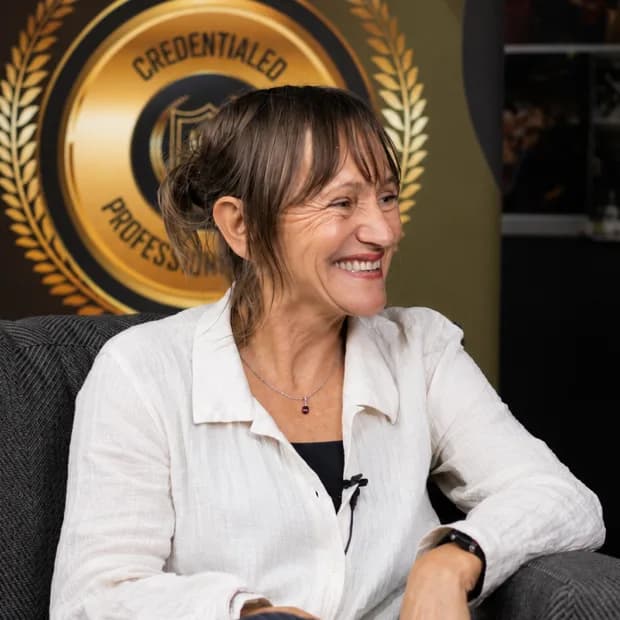
Andrea Buck is a coach and a lifetime member of the International Coaching Institute. She works with people in the creative industries, producers, directors, writers, actors and musicians who want a career that is successful and also their own. Andrea started out as an analyst programmer, went on to produce film, and rebuilt her career from the ground up after a burst brain aneurysm. Her work now is helping people find the genius they were talked out of, and build a life that can hold it.
Join the email list and get the free How to Become a Successful Coach Starter Kit: an honest place to begin, sent straight to your inbox.
Want to go deeper? Join the free training, a warm, no pressure live session on what coaching really is, and whether it might be for you.
A one to one with a professional coach: a chance to gain clarity, set your goals, and plan your pathway. Book your free call today and start the conversation now.
Book your free call