Join the mailing list plus receive your free How to Become a Successful Coach Starter Kit.
Join + get your Starter Kit
Real people. Real stories. Real success. With Rashid Mubashir.
© 2026 How to Become a Successful Coach
Real people. Real stories. Real success. With Rashid Mubashir.
Your partner is a mirror, reflecting the parts of yourself you have yet to meet.
Marc Wiesner is a Relationship Coach from Melbourne who helps couples rebuild trust and reconnect after years of conflict. In this conversation, he and Rashid explore why couples fall out of love, the three phases every relationship moves through, and the idea that your partner is a mirror, reflecting the parts of yourself you have yet to meet. A tender, honest look at how the struggle in a relationship can become the doorway to growth, for you, your partner, and even your children.
Every relationship moves through phases. Most couples get stuck in the power struggle, and that is exactly where the growth is waiting.
Your partner is a mirror. The things that trigger you often point to the parts of yourself you have disowned.
Trust is broken less by the dramatic moments and more by the small ones: broken promises, not following through, not making each other a priority.
Attachment styles are formed early, but they are not a life sentence. With awareness and commitment, they can be healed.
The deepest form of self-love is learning to be with yourself in the hard moments, not just the happy ones. Heal it in yourself, and you pass it on to your children.
Prefer to read? Download the transcript, or open it right here.
Welcome to this podcast. Today my guest is Marc Wiesner, who is a relationship coach from Melbourne, Australia. In this conversation we explored together how Marc helps couples who have been in conflict and perhaps have lost their connection for a really long time, rebuild their trust. Finally reconnect and deepen their love so they can be together and bring their family together. Welcome back. Thank you for joining me in this conversation.
Thanks, Rashid. It's a pleasure to be here.
Yeah. It's awesome. And I'm really excited about this conversation because it's such an important conversation. It is every household conversation, whether you're a coach or you're not, whether you're a mom or dad, whether you're someone who's single and thinking about being in relationship in your own life. So first of all, phenomenal impact that you're creating. I just want acknowledge that the number of people you're helping in couples and families, it's fantastic. And your education and journey here at the institute has been a great example of what's possible for someone who wants to help people the way you are. So I'd love to start with a straight into a question around relationships.
Sure.
So tell us a little bit about what's the number one thing that you notice or theme that you notice in people that you coach? In terms of what creates this level of conflict or distrust or what causes that drifting apart of people in their relationships.
Let's start dating. Wow. We're going from 0 to 100. I love it. And I am so passionate about this topic. And is it okay if I give it a bit of context about some of the frames that I go for? In a way, yeah. So it's an incredible question. And look, there's there's depending where you look at, there's three key phases of a relationship. There's the honeymoon phase, can last anywhere from two months to two years where everything's just perfect. I think we've all been there. The chemistry is flowing. We can't look at the other person without seeing perfection and anything said anything they do like. And that might potentially annoy as we just we we can we can block it out.
And then we move into the next phase, which is the power struggle phase. And a lot of couples literally get stuck here. And this is typically where I'll help help my couples and the goal for me is to get them into the mature phase of their relationship, where the wise adult is there, where they can make conscious choices, where they can appreciate the differences in their partner.
And so this power struggle phase, this is the phase where we're questioning is, is this the relationship for me? Should I be here? And the couples that come to me, there might be a series of issues. There might be infidelity. There might be substance abuse, there might be anger control issues, or they might have jumped into what they perceive to be too fast. And that normally happens once they've kind of towards the end of the honeymoon period and reality start to hit, and all the positive emotion is starting to settle down a little bit.
And so what do you know? This is the reason. Let's start with that. Why people move into this power struggle, so to say, where they're not feeling as honeymoon ish anymore.
Look, if we go from a global point of view and I don't know your perspective on this, but I think it's evolution and Gabor Maté. He shares that when we were attracted to someone, that there is the we're attracted to parts of ourselves that way. Have we sort of, don't own within ourselves. So you know, in a typical dynamic, the, the, the attachment style, we have maybe an anxious, I think 67% of heterosexual couples, we have the anxious female and maybe the avoidant man, and she will love his calm energy and he will love her energy. Sort of the feistiness.
Yeah, yeah, yeah.
And then suddenly, the chemicals have worn off the dopamine, the serotonin, all this good stuff, and they're like, oh, actually, unconsciously, Gabo says we're attracted to those parts. We want to heal within ourselves. And this is always the frame that I'm, I'm sort of working with. You're in the relationship you need to be in to heal those parts of yourself.
Yeah, that's really cool. Yeah. The way I'm hearing that is. So whatever relationship we're in, it is a mirror reflection of where is it that we haven't yet seen those qualities within ourselves that we are admiring in our partner?
And so that's really profound, because that invites us to consider that every relationship, not just marriage. And I know that we're going to go deeper with that. But every relationship is a mirror which is revealing to us the triggers, the wounds, the hurt that we are carrying. Or, like you said, the dismemberment or the discernment of the qualities.
I think I think the greatest form of self-love is learning how to be with ourselves, and not just learning how to be with ourselves when we're excited and joyful, but learning how to be with ourselves when we are uncomfortable, feeling like feeling defeated in life because of some situation, circumstance, or person or way of feeling upset, sad, angry. Whatever emotional experience we're having across the broad range of experiences, you know, learning how to be with us in those moments, it's like the greatest act of self-love it is. I don't think there's anything greater than that. Then recognizing that you're having a human moment in this consciousness, which is fantastic.
So so I love that because I resonate with it too. And I imagine a lot of the viewers here, I can resonate with the idea as well, that the first step is within us to learn how to be safe within ourselves and how to accept our own emotional experience.
Yeah.
And then and that's a need to look after. Then the need to be able to experience our emotions and love ourselves in that way. What is the need that you could lean on your partner for?
Look, all of it need to be loved is also healthy to to to expect and desire and communication your partner. So maybe maybe it comes down to like giving yourself enough time to think about which aspects of it can I look after myself and which aspects I can trust my partner with?
Yeah. And I think it comes full circle to those those really raw spots within ourselves and our vulnerability. And so I can take care of myself to a certain point. But I think the science is proven. Kids need 1% co-regulation. Adults need probably 50% co-regulation. That's sort of what they've they've shared.
So what do you mean by co-regulation.
It's the frame of the conversation. I can be with you in your mess, in your sadness, in your anger and in your fear. You don't have to do it alone. You don't have to do it alone.
And what we. Yeah. So and this is that vulnerability part. I have a real raw spot around this. Where in a relationship together. Can you can you love me because of that? Not in spite of that. That makes sense. Yeah.
And so I can share with you that. Yeah, I have this wound in this area. Can you be gentle and care for me in that way that I need, and be really kind and compassionate around that? And then I will do the same for yours. Yeah.
Yeah, I love that. I think that's in in some way, the spirit of marriage or deep relationships where we learn to recognize each other's humanity and hold it with kindness and gentleness.
Oh, that's so important. Yeah, yeah. Wow. This is amazing work you're doing, Marc. Thanks for that. And that that power struggle phase is exactly the opposite of that. I'm going to protect my raw spot with anger, with defense, with criticism, with withdrawal.
And in moving from that power struggle to the to the mature relationship.
Is that transition? Yeah.
I love you for your for your humanity, for your raw spot.
Yeah, yeah. You take care of that for you. Yeah. In the way you need and seeing a couple through that journey is so profound. And then they get to do it for their kids.
Yeah. Which a skill that a lot of us haven't developed. And so and this, this is that tribal cycle that I love it when it gets sort of, healed and nurtured so that I can be now with my kids and in their mess and not shut them down, not criticize them for. It's so beautiful, really powerful.
Because we pass on to our children the behaviors we haven't yet healed in ourselves as well.
Yeah. So that's really powerful. So there's this depth of intergenerational change that comes about as a result of the work that we do on ourselves, which I think is really, really powerful. And a lot of people often wait a really long time in their lives to to do this journey. But I love that you're of course encouraging people with this powerful message of how their lives could be different in their families and their coming generations could transform now now, which is a about yeah, I know, yeah. Dig it.
Marc, I think we could continue chatting for a really, really long time. And we should continue. But I just want to say thank you for taking out the time and being here and doing this conversation with us, sharing with us, how people experience relationships and how to get to that maturity.
Thank you. So it's such a privilege. Thank you.
Yeah, yeah, that was awesome. Hugs. Maybe like a hug. Thank you again.
Oh, I love you, but I love how you express yourself.
Well, it's really cool. I really enjoyed that conversation.
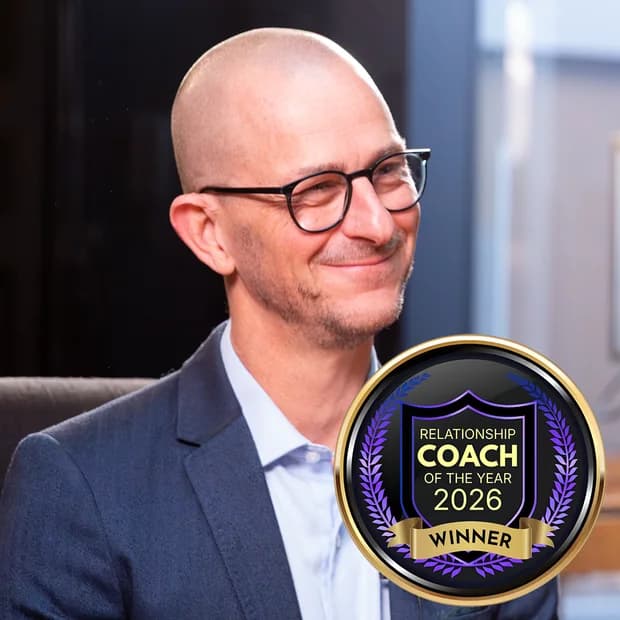
Marc Wiesner is a Relationship Coach based in Melbourne who helps couples move from conflict and disconnection back to trust, closeness and love. Trained at the International Coaching Institute, he works with individuals and couples to heal the patterns that keep them stuck, so they can build a relationship that transforms their family too.
Join the email list and get the free How to Become a Successful Coach Starter Kit: an honest place to begin, sent straight to your inbox.
Want to go deeper? Join the free training, a warm, no pressure live session on what coaching really is, and whether it might be for you.
A one to one with a professional coach: a chance to gain clarity, set your goals, and plan your pathway. Book your free call today and start the conversation now.
Book your free call