Join the mailing list plus receive your free How to Become a Successful Coach Starter Kit.
Join + get your Starter Kit
Real people. Real stories. Real success. With Rashid Mubashir.
© 2026 How to Become a Successful Coach
Real people. Real stories. Real success. With Rashid Mubashir.
Why money is really a conversation about what you believe you are worth.
Most of us were taught how to budget. Very few of us were taught how to invest, how to read a super statement, or how to ask for what we are worth without feeling like we are rocking the boat. Antonietta Muraca has spent years on both sides of that gap, first as an accountant, now as a coach working with women on wealth.
In this conversation she and Rashid start with her central idea, that money is a reflection of how we feel about ourselves, and follow it into the practical places it shows up. Why so many capable women hold everything together and still keep their distance from the family’s financial decisions. Where the money story we carry comes from, and how early it sets in. Why asking for the pay rise can feel harder than earning it.
Rashid brings it home with a conversation he had at his own kitchen table, and they get into what Antonietta calls aligned love and aligned wealth, the money conversations most couples avoid. She then walks through the four buckets she teaches in her workshops, starting with the first thousand dollars and building from there.
She finishes with the question she leaves every woman with: what does your rich life actually look like, and what do the zeros in the account let you do with it?
Money is a reflection of how we feel about ourselves. What we believe we are capable of receiving shows up in what we have.
Many of us were taught to budget and never taught to invest. The further we sit from the financial decisions, the further we sit from what is possible.
Everyone carries a money story, usually inherited. Asking what you grew up learning about money is where it starts to change.
You do not need a lot to begin. Small, consistent steps compound, and it is never too late to start.
A woman is worthy of any seat at any table she chooses, and free to leave a table where respect is not being served.
This is not only a women’s conversation. Rashid shares that even in a relationship where money is talked about openly, asking how the finances are actually managed can still be the hard question.
Antonietta’s four buckets: an emergency fund, your super, your home, then investing beyond that. Start with the first one.
Prefer to read? Download the transcript, or open it right here.
Welcome to this episode of How to Become a Successful Coach. And we are here today with a wonderful woman, Antonietta Muraca, who is a coach for women who want to become empowered and wealthy in their lives. Welcome to this episode. I'm so pleased to get to do this.
Thank you for inviting me to be here.
So welcome. So happy to be here. You're so welcome. And tonight we're going to get straight into it. Let's start with tell me what you mean when you do this work. When you say your net worth is determined by your self-worth. So often we think as women, we think that our net worth is actually tied to spreadsheets or budgets or numbers. But it is far more greater than that. It actually starts from within who we think we are, what we think we are capable of being, and what we think we are capable of receiving. And we are all worthy of abundance.
That's beautiful or worthy of creating. Well, yeah, I love that. Now, I do have a question around that, though. It sounds like a poetic way of saying, hey, you can be wealthy and you can have net worth if you know who you are within and if you believe in abundance. But how does that translate practically into the real world? Like if I'm a mom right now watching this and I'm thinking, well, I think I have abundance and I think I, I believe that I want to be wealthy and I am worthy of being wealthy, but that doesn't show up in my assets or net worth.
I wonder whether it shows up in your everyday life. I would reverse that and show how does that show up in your everyday life? Too often as women, we're to the outside world. We're holding it all together. But are we questioning ourselves when it comes to being capable of creating well? Do we question ourselves? Do or do? More importantly, do we distance ourselves from financial decision making in the family?
For many generations, women have been running a family on a budget. But and we know how to budget. But has anyone taught us how to invest? Has anyone taught us that to look at our financial paddle, interpret it? Have to look at our superannuation statement. The further we distance ourselves from the financial decision making, the further we distance ourselves from wealth creation and what becomes possible for us.
And how do you relate that to self-worth though? To self worth? Because often it's our network. Money is a reflection of how we feel about it. Do we feel we are worthy? Are creating well? Do we feel that we are worthy of abundance? Do we think we were the other pay rise? Do we feel that we are worthy of a right at any seat of the table?
That's where this all started from. A woman is worthy of any seat at any table she chooses, and she can also leave that table when respect or trust or whatever it is, isn't being served at that table. Yeah, yeah, I think so. Yeah. And so how we feel about knowing that we are enough as we are, knowing that we are worthy of making financial decisions on our own. Having the confidence to just take action. We feel we need to have a lot to start investing, but we don't. It's just like going to the gym. We don't build muscle overnight. We build muscle by taking small, consistent discipline steps. The same is true. Well, you don't need to have a lot of money to make financial decisions now. We just need to trust ourselves to have confidence in that decision making and to take the small discipline steps, whether it be automating, whether it be increasing your super by even 1 percent, those little steps can make such a big difference. Because we have compounding. It makes such a big difference to where we can be in the future, and it's never too late to start.
We feel that many women feel that they've left or to late. That's a very important conversation, particularly with some of the statistics that are now out, which are increasingly pointing to how women are getting to particularly in Australia. Women are getting to the retirement age and they have far less in their wealth bank, you might say, or their backup to have financial security compared to men. And it's not a function of gender. It's a function of choices and circumstances that some women may have chosen, for example, being a mom and taking extended periods off and things like that.
And I love that you are opening up the conversation that there is a there's more depth to this challenge rather than only what you're doing, which is the self-worth part. So I'm curious about that. If it's okay, I want to keep digging there a little bit more. So what's happening in someone's mind, a woman's mind, when they are not making the decisions that they should be making, or when they're struggling to be disciplined? Like, what's the internal talk in a woman's life that is making them place full in some way?
Yeah, that I'm not worthy of it there. We deem our wattage. A lot of times as women, we deem our wattage for the sake of keeping peace, for the sake of not rocking the boat or the sake of, you know, if we question our financial circumstances, you know, if we dare to take ownership of it, will we how will we feel make our male counterpart feel, you know, are we deflating their ego if we build our wealth?
Wow. There's there's a lot to it. And unfortunately, women in their 50s are the fastest growing demographics living in poverty. Not because they didn't. They did anything wrong. They haven't done anything wrong. But we don't have the structures and the support systems, and we weren't encouraged to invest and take ownership of it. We have superannuation. We are blessed in Australia to have superannuation now, especially for the younger people. It's 12 percent of their gross income gets paid into by their employer, into a super fund, and we don't take ownership of that. The annual statement comes out and we many women don't even open that envelope.
But what happens if we could look inside and have a look at this as our second greatest investment, other than our home? It could very well be our second greatest investment and women of today. Whereas future past generations didn't have compulsory silver, we take long breaks from the workforce, whereas now you're paid, paid parental leave. And on top of that you also get paid super. So all these benefits are there. Correct. And just taking more be more proactive. Yeah. So that's a good point.
And I'm curious, why do you think that women in general find themselves being passive? I understand the self-worth element of it and the internal narrative that you've shared. What holds them back from making this a priority? Number one, it comes through education. That is something that comes through and through in every workshop. We have been taught that in schools. So that's first where it comes and maybe within our cultures to within our upbringing, the conversations we had, you know, often there's a stigma about money. You know, rich people are greedy or, you know, you can't ask for this, you know, it's too selfish to selfish. And so all those conversations that money mindset sets in from such an early stage.
But it wasn't have to be. It doesn't have to be a huge mansion. It just means to be something that is uniquely yours. Beautiful. How do you manage the third bucket? What do you recommend? The first bucket or third bucket? The third bucket. How do you manage that is never over capitalize. What do you mean? I think if we're investing in what would suit your needs. It's your basic needs. Not competing with anyone else, but what would meet your needs for a home and security? It may be for some people, it may be a little two bedroom cottage, and for others it may be an apartment or for downsizing.
As you get older so that you have some more money to put into superannuation as well. Thinking of it as our primary place of residence is still the most tax effective structure. We don't often talk about it as an investment because it encompasses so many other values and needs. But it is. Let's not kid ourselves. It is. It's an investment that we make for our security, but also to provide. And if we can do that while we're younger, it gives us something that we can sell and downsize to and then still have more leftover for superannuation.
But it's also important that as women, we know what our mortgage repayments are. We know what our liabilities are, that we know what our net worth is as a family. Yeah, because a further we are from the decision making, the higher we are at risk of losing it all as well. Yeah. This is very insightful. So that's the third bucket which is how you view having a home, owning a home and then getting to that security as quickly as we can.
And then what's the last bucket. And then if you've got something left over after meeting all those then we can invest outside of superannuation. So whether that be in ETFs or shares or grow in our own business. So I think at any point of time, you know, when we are, when we actually are living our rich life, we would have those four opportunities.
Yeah. Yeah. That's powerful. Now when I think about those buckets, I can see clear categories of how anyone could add the most fundamental level without making it complex, start to build some structure in their wealth. Yeah. What would you say is the role of coaching in helping people manage their finances better? Aside from strategies and steps which accountants or professionals will do which is phenomenal and needed?
Where do you think coaching steps in? Because now I know you're being an accountant before now being a professional courage. What's the element that may have been missing that you're noticing? As a successful coach? You're able to help people with some an education like point of view as an educator, as an accountant. And we don't have those conversations about wealth creation necessarily, you know, and what it means to create work, to know that you are worthy of the wealth, that you are worthy of creating, that you even have the capability of changing your money story.
The money story we carry are often those of our parents or our friends, or the trauma or the trauma that we have the opportunity to rewrite our own stories. We have the opportunity to create a life that is aligned with our highest values. And when you can live a life lined with your highest values, we will always do a values elicitation exercise as part of our workshop. Because when you are when your money mindset changes so that it is in living a life aligned with my values, then feeling those four buckets doesn't come from a place of restriction nice, or a burden, or a burden or confinement. It opens it up to what becomes possible.
Yeah, to to live in a life of purpose from being an excess. Yes. Move from being an expense to being joy and certainty and. Yeah, from from restriction to creation. I love that to self leadership. Yeah. It's pretty comfortable. And those conversations I imagine matter so much more because a lot of people see going to an accountant or just managing money or creating wealth as a chore or as a, as a, a burden, or has a heavy weight on them because of the story.
So what you're doing is you're helping them change the story. You're helping them see how it is aligned with who they are authentically. I think it's knowing your why, knowing your why, knowing what your highest values are. And everything we do then is living in alignment with our highest values, taking away the validation from anything else. We don't need a designer handbag to validate who we are.
When you're living a life aligned with your highest values, all the external stuff doesn't matter. You come back to south, you come back to what's truly important in your life. Well said. And it has so much more meaning, so much more purpose. Yeah. That's beautiful. What would you say to someone who's watching this conversation right now? And they're thinking about changing their own life, and they're building more wealth, their own wealth story.
What would your one step be that could help them change their wealth story right now? Define your rich life. What does that look like for you, irrespective of the number of zeros in your bank account? But what that creates for you and your family and the legacy, that's really good. And imagine if there's an exercise on that or something like that that you would love to share.
And we can drop it somewhere down below in this podcast as well. So people could just go in and do a bit of an exercise. Would that be cool for you? That'd be great. That's awesome. Forward to it. Yeah, what a wonderful way to give back. And I want to say thank you to you. We could keep chatting for a really long time.
I'm sure every time I have a guest here in the podcast, we get chatting. And I think it's an incredible way to be able to make a difference in the world. I want to say congratulations to you on the impact you're creating as a successful coach, really changing the narrative around wealth by going to the heart of it, which is who we are, our psychology and how we approach it. So thank you for being with us here today and sharing your wisdom.
Thank you for the opportunity to share and all you do for everyone outside the community.
Thank you. You're so welcome. I'd love to give you a hug.
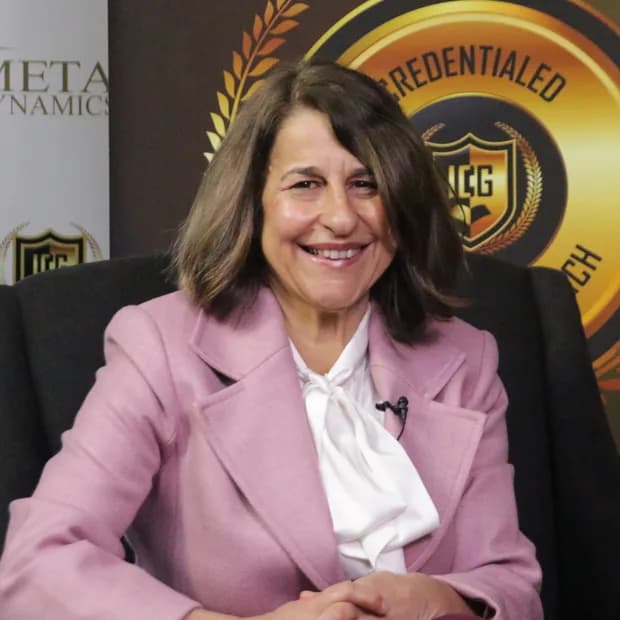
Antonietta Muraca is a former accountant, now a coach working with women on wealth creation and financial confidence. Through her workshops she helps women rewrite the money story they inherited, take ownership of their finances, and build wealth in a way that is aligned with what they actually value. Her work is grounded in a simple idea: a woman is worthy of any seat at any table she chooses.
Join the email list and get the free How to Become a Successful Coach Starter Kit: an honest place to begin, sent straight to your inbox.
Want to go deeper? Join the free training, a warm, no pressure live session on what coaching really is, and whether it might be for you.
A one to one with a professional coach: a chance to gain clarity, set your goals, and plan your pathway. Book your free call today and start the conversation now.
Book your free call